

Dr Srishti Jauhar, Dentist & Clinical Director, The Dentist — 23+ years of clinical experience; 4,500+ root canal treatments; Fellowship in Rotary Endodontics (IARE, USA). She follows an ethical, conservative and patient-first approach, with a strong focus on preserving natural teeth whenever reasonably possible. Through these articles, she shares her clinical experience to help patients better understand their dental problems and treatment options, and make informed decisions about their care.
In this article
The Case
The case · What I found when I examined the tooth · Why I decided not to proceed directly to root canal treatment
The Treatment & Outcome
How we treated the tooth while preserving the pulp · Why the tooth needed more than a simple filling · The outcome
Understanding Your Options
When root canal treatment is the right treatment · What is vital pulp therapy? · Should you get a second opinion?
Frequently Asked Questions
Frequently asked questions about avoiding root canal treatment
Can root canal treatment always be avoided?
If you have been told that you need a root canal, it is natural to wonder whether there is another way to save the tooth.
I understand that hesitation. A root canal is a significant treatment decision, and once it has been recommended, many patients simply want to know one thing:
“Do I really need it?”
The answer cannot be determined by pain alone.
When I assess a tooth that has been advised for root canal treatment, I look at the complete clinical picture: the patient’s symptoms and history, the condition of the tooth and any existing filling or restoration, the findings on examination, pulp sensibility testing and the dental X-rays.
The purpose is not to avoid root canal treatment at all costs. Root canal treatment is an important and predictable treatment when the pulp is irreversibly damaged or when endodontic treatment is otherwise indicated.
But there are also cases in which the tooth may still have a reasonable opportunity to be treated more conservatively.
I recently saw one such case.
The patient came to me with significant pain in a lower molar and had already been advised root canal treatment at other clinics.
The symptoms were serious enough that a root canal seemed like a reasonable possibility. But when I examined the tooth carefully, there were findings that made me pause before committing to an irreversible treatment.
The question became:
Could we treat the cause of the problem while preserving the tooth’s natural pulp?
In this case, the answer was yes.
This is the story of how we approached that tooth, why I decided not to proceed directly to root canal treatment, and what the case can — and cannot — tell us about avoiding a root canal.
Most importantly, it illustrates a principle I consider fundamental to conservative dentistry:
The right treatment begins with the right diagnosis.
Why tooth pain does not always mean you need a root canal
Tooth pain can be a sign that the pulp inside a tooth is inflamed or infected. But pain by itself does not tell us exactly what is happening inside the tooth.
Two teeth can produce very similar symptoms — pain, sensitivity to hot or cold, or discomfort while chewing. Yet they require very different treatment.
A tooth may hurt because of deep decay, a leaking or failing restoration, a crack, trauma, or inflammation of the pulp. In some situations, the pulp may still have the potential to remain healthy after the cause of irritation is treated. In others, the damage may be irreversible and root canal treatment may be the appropriate way to save the tooth.
This is why I would not make a root canal decision based on the intensity of pain alone.
What matters is the condition of the pulp
The pulp is the living tissue inside the tooth that contains nerves and blood vessels. When it becomes severely and irreversibly inflamed or infected, root canal treatment may be necessary.
But if the pulp is still capable of recovering, there may be circumstances in which a more conservative treatment can be considered.
The important question is therefore not simply:
“How much does the tooth hurt?”
It is:
“What is causing the pain, and what is the condition of the pulp?”
Answering that requires a proper clinical assessment rather than relying on any single symptom or test.
A careful diagnosis comes before the treatment decision
When I see a patient who has already been advised a root canal, I first want to understand the tooth before deciding what treatment it needs.
I consider the patient’s symptoms and dental history, examine the tooth and its existing restoration, assess the pulp using appropriate sensibility tests, and study the dental X-rays.
The X-ray can provide important information about the tooth, its roots and the surrounding bone. Pulp sensibility testing provides another piece of the diagnostic picture.
Neither should be interpreted in isolation.
The findings have to be considered together before deciding whether root canal treatment is necessary or whether a conservative approach may be appropriate.
That distinction is important. Because the aim is not to avoid root canal treatment simply because a patient wants to avoid it. The aim is to avoid unnecessary treatment while providing root canal treatment when the tooth genuinely needs it.
That is the approach I took with the patient in this case.
How I assess whether a root canal is actually necessary
When a patient comes to me after being advised a root canal, I do not want to make the decision simply by looking at the previous recommendation. I want to understand the tooth for myself.
There are several pieces to that assessment, and each tells me something different.
Your symptoms and dental history
I start by listening carefully to what the patient has experienced.
When did the pain begin? Is it triggered by cold or hot foods? Does it stop quickly, or does it linger? Does the tooth hurt when biting or chewing? Has there been swelling? Has the tooth been filled, treated or injured previously?
These details help build a picture of what may be happening, but symptoms alone are not enough to establish the diagnosis.
Clinical examination
I then examine the tooth itself.
First, I look for visible decay, a failing or leaking restoration, cracks or other structural problems. Then I also assess the tooth. And the surrounding tissues clinically to understand whether the symptoms can be traced to this particular tooth.
Sometimes the source of pain is not where a patient expects it to be, which is another reason a careful examination matters.
Pulp sensibility testing
The next part of the assessment is understanding how the pulp is responding.
Cold testing and, where appropriate, other sensibility tests can provide useful information about the sensory response of the pulp. These tests do not directly measure the blood supply of the pulp, so they are more accurately described as pulp sensibility tests rather than vitality tests.
The result is interpreted alongside the patient’s symptoms, clinical findings and radiographs. A response to testing is an important piece of information, but it does not by itself prove that a tooth does or does not need root canal treatment.
Dental X-rays and the surrounding bone
Radiographs help me look beyond what can be seen clinically.
I assess the depth and extent of existing restorations or decay, the roots and surrounding bone, and whether there are any visible changes around the root tip.
The absence of a visible change around the root tip can be reassuring, but it does not by itself rule out significant pulpal disease. The radiograph has to be interpreted together with the clinical findings.
Looking at the whole picture
Ultimately, the decision is not based on one symptom, one X-ray or one test.
It comes from putting all of the information together:
What is the patient experiencing? What is happening in the tooth? How is the pulp responding? What do the radiographs show? And is there a conservative treatment that has a reasonable chance of preserving the tooth and its pulp?
That is the assessment I made in the case I am about to describe.
The case: a painful lower molar that had already been advised for root canal treatment
The patient came to me with significant pain in a lower right molar — Tooth 46.
Eating had become difficult. Hot and cold foods were triggering pain, and there was lingering discomfort that had begun to interfere with everyday life.
The tooth had previously been restored with a filling, and the symptoms had gradually worsened over time.
Before coming to The Dentist, the patient had consulted multiple clinics and had been advised to undergo root canal treatment.
Given the symptoms, that recommendation was understandable.
But the patient wanted another opinion before proceeding with an irreversible treatment.
The question was simple:
Could this tooth still be treated without removing its natural pulp?
To answer that, I needed to assess the tooth carefully rather than assume that the previous recommendation was either right or wrong.
I began with the clinical and radiographic findings.
What I found when I examined the tooth
The first part of the assessment was the dental X-ray.
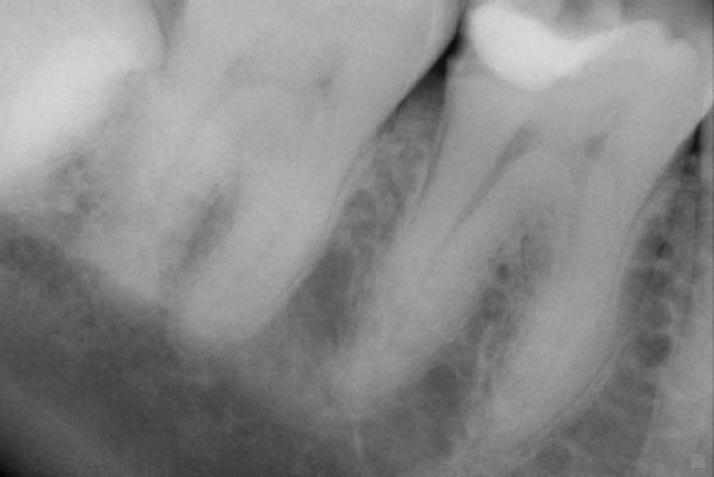
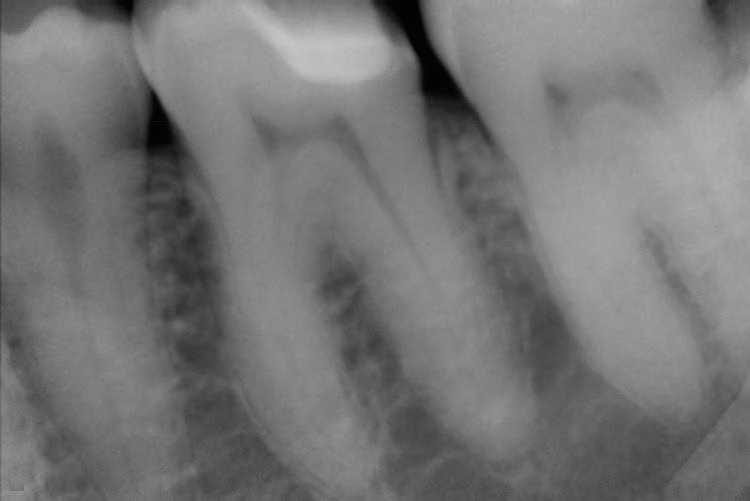
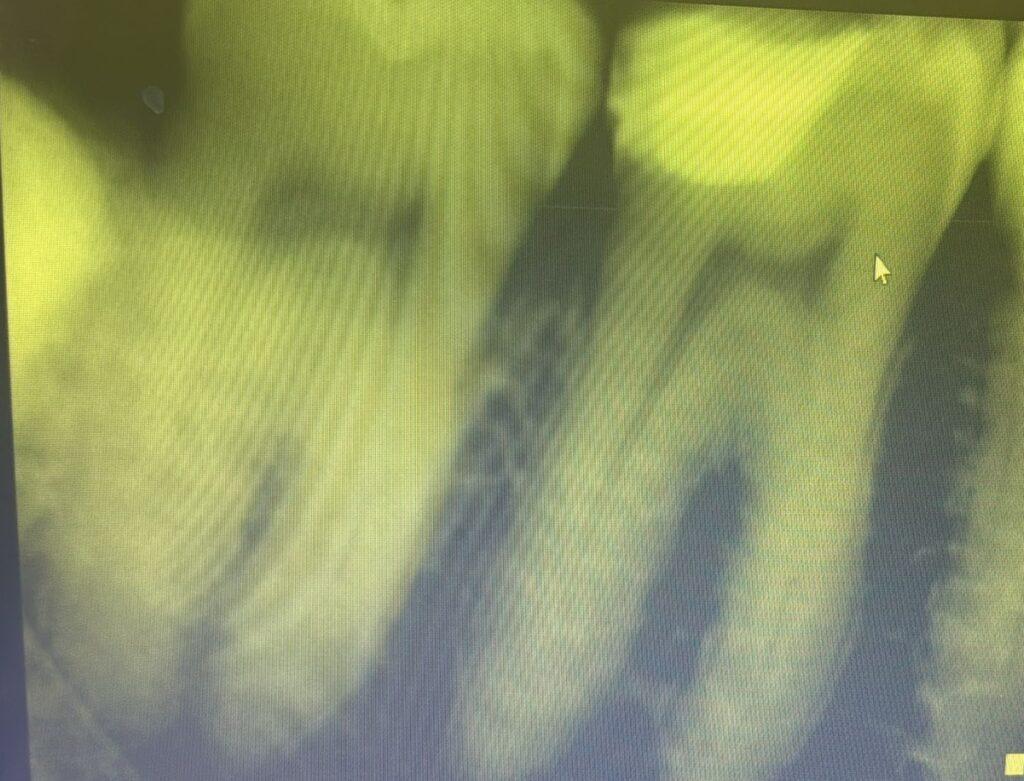
(Pre-treatment dental X-ray showing the deep existing restoration in the affected lower molar, with no visible periapical changes around the root tip.)
It showed a deep, old filling in the affected molar. The seal around the restoration appeared to have broken down, allowing the possibility of bacterial leakage beneath the filling and irritation of the deeper tooth structure.
This provided a possible explanation for the patient’s symptoms.
But there was another important finding.
There were no visible periapical changes around the root tip.
In other words, the X-ray did not show a visible abnormality in the surrounding bone at the apex of the tooth.
That was useful information, but it was not enough on its own to decide against root canal treatment.
An X-ray cannot tell us everything about the condition of the pulp. I therefore needed to consider the clinical findings and the pulp’s response to sensibility testing as well.
The pulp was still responding
The tooth responded positively to pulp sensibility testing.
This was an important finding because it indicated that the pulp was responding to the test stimulus.
However, I did not interpret that result in isolation. A positive sensibility response does not, by itself, establish that the pulp is healthy or that root canal treatment is unnecessary.
I considered it together with the patient’s symptoms, the clinical examination and the radiographic findings.
Taken as a whole, the findings suggested that there was a possibility of treating the tooth conservatively rather than proceeding directly to root canal treatment.
That possibility needed to be weighed carefully against the risks of preserving the pulp.
The next decision was therefore not simply “How can we avoid a root canal?”
It was:
“Does this tooth have a reasonable chance of recovering if we remove the source of irritation and restore it appropriately?”
Why I decided not to proceed directly to root canal treatment
At this point, I had to make a clinical decision.
The patient was experiencing significant pain, so simply assuming that the tooth could be left untreated was not an option. At the same time, the findings did not make it necessary to proceed immediately with root canal treatment without considering whether the natural pulp could still be preserved.
Several findings were important when considered together:
- The tooth had a deep, old filling that appeared to have lost its seal.
- There was a possible source of bacterial leakage and irritation beneath the existing restoration.
- The tooth responded to pulp sensibility testing.
- There were no visible periapical changes around the root tip.
- The tooth still had sufficient structure to consider restorative treatment.
None of these findings, by itself, was enough to rule out root canal treatment. The decision came from looking at the complete clinical picture.
My thinking was that if the source of irritation could be removed and the tooth could then be properly sealed and restored, there was a reasonable possibility that the pulp could remain functional and the tooth could settle.
So, rather than removing the pulp immediately, I decided to take a conservative approach and treat the underlying problem while giving the natural pulp an opportunity to recover.
This was not a decision to avoid root canal treatment at all costs.
It was a decision to preserve the pulp because, in this particular case, I felt there was a reasonable and clinically appropriate opportunity to do so.
It is also important to say that this does not necessarily mean that the earlier recommendations for root canal treatment were wrong. Dentists may reach different treatment decisions based on the findings available to them, the clinical examination and how the symptoms and tests are interpreted.
The important question for me was not whether a root canal had previously been recommended.
It was whether, after my own examination, this tooth could reasonably be treated without proceeding directly to root canal treatment.
In this case, I felt it was worth trying.
How we treated the tooth while preserving the pulp
Once we decided to take a conservative approach, the next priority was to remove the source of irritation and restore the tooth in a way that protected the remaining healthy tooth structure.
The treatment was carried out under local anaesthesia and with a rubber dam to maintain a clean, controlled working field.
The old filling was carefully removed so that I could assess the tooth underneath it. The compromised tooth structure was then selectively removed, while taking care not to sacrifice sound tooth structure unnecessarily.
At the deeper part of the cavity, a biocompatible material was placed to help protect the underlying pulp.
The tooth was then rebuilt using a fibre-reinforced composite material.
Because the tooth had already lost a significant amount of structure, I did not consider a simple filling sufficient for long-term restoration. We therefore planned an indirect onlay to provide better coverage and protection.
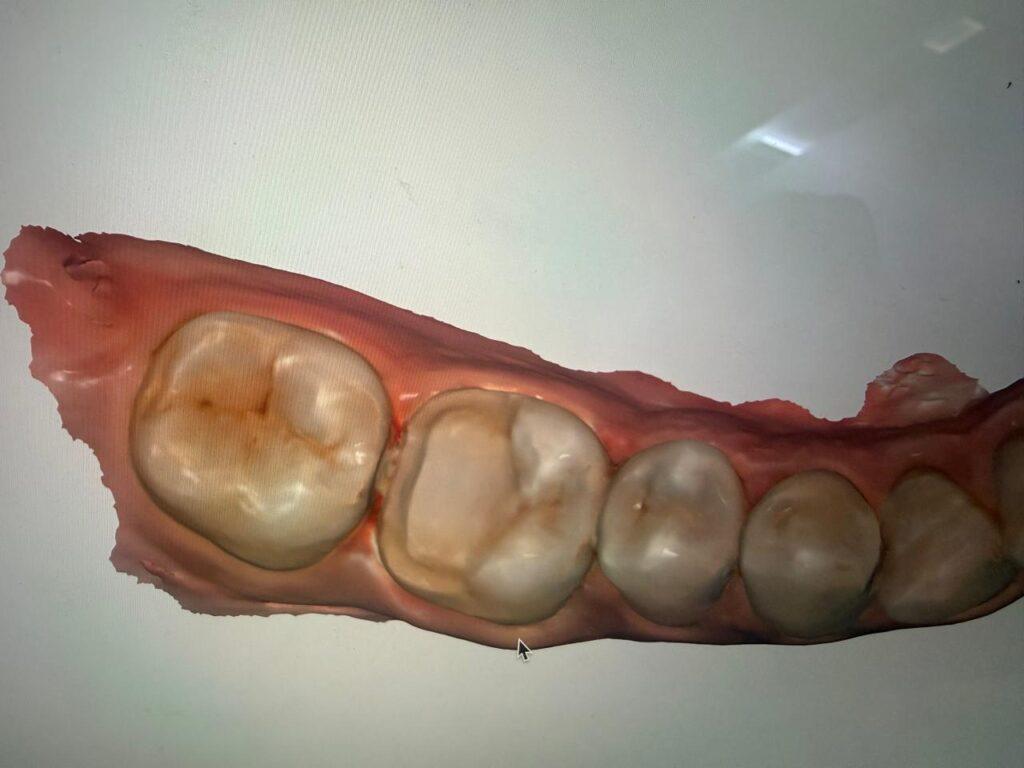
The tooth was digitally scanned, and the onlay was subsequently bonded to the tooth using adhesive cement.
The objective throughout the procedure was straightforward:
Remove the source of irritation, protect the remaining tooth structure and pulp, and restore the tooth without unnecessarily removing the natural pulp.
This approach allowed us to preserve the tooth while still providing the structural protection it needed.
Why the tooth needed more than a simple filling
Preserving the pulp did not mean that the tooth could simply be given another filling and left as it was.
The old restoration had already failed to provide an adequate seal, and removing the compromised filling and damaged tooth structure left the molar with a significant amount of structural loss.
A tooth in this condition needs to be restored with its long-term strength and function in mind.
That is why, after protecting the deeper part of the tooth and rebuilding the lost structure with fibre-reinforced composite, we chose an indirect onlay rather than relying on a conventional filling alone.
The onlay provided additional coverage and helped protect the remaining tooth structure during normal chewing.
This distinction is important.
Preserving the natural pulp and restoring the tooth properly are two separate parts of the treatment.
The goal was not simply to avoid a root canal. It was to leave the patient with a tooth that was both biologically preserved and adequately restored.
The outcome: the pain resolved and the natural tooth was preserved
After the treatment, the patient’s pain settled and the tooth became comfortable enough for normal chewing again.
The sensitivity that had been troubling the patient also reduced significantly.
Most importantly, we were able to preserve the natural tooth without proceeding with root canal treatment at that stage.
For me, this was a satisfying outcome not simply because we avoided a root canal, but because we were able to address the likely source of the problem while preserving the tooth’s natural pulp and restoring the tooth appropriately.
However, I would not want this single case to create the impression that a painful tooth can generally be treated without root canal treatment.
It cannot.
The outcome in this case depended on the condition of this particular tooth, the clinical findings and the assessment made before treatment. Other teeth with similar symptoms may have a very different diagnosis and may genuinely require root canal treatment.
That distinction is important when considering whether a root canal can be avoided.
Does this mean every painful tooth can avoid a root canal?
No.
This case should not be interpreted as evidence that root canal treatment is unnecessary whenever a tooth is painful.
Some painful teeth have pulp inflammation or damage that cannot predictably recover. In those situations, root canal treatment may be the appropriate way to remove the diseased pulp, control infection and retain the tooth.
Other teeth may have a different problem that can be managed more conservatively, provided the tooth and pulp meet the clinical requirements for that approach.
That is why I would not make the treatment decision based on pain intensity alone.
Two patients can have similar symptoms but require completely different treatment.
The important questions are:
- What is causing the pain?
- What is the condition of the pulp?
- What does the clinical examination show?
- What do the X-rays show?
- Is the tooth structurally restorable?
- Is there a reasonable and predictable way to treat the problem while preserving the pulp?
If the answer to these questions supports pulp preservation, a conservative treatment may be worth considering.
If the pulp is irreversibly damaged, infected or otherwise unlikely to recover, trying to avoid a root canal can do more harm than good.
The goal should not be to avoid root canal treatment. The goal should be to choose the least invasive treatment that is appropriate and predictable for that particular tooth.
When root canal treatment is the right treatment
Root canal treatment is an important treatment when the dental pulp has been irreversibly damaged or when endodontic treatment is otherwise indicated.
The aim is not to avoid root canal treatment whenever possible. It is to recognise when the pulp is unlikely to recover and treat the tooth appropriately rather than trying to preserve tissue that cannot be predictably preserved.
Root canal treatment may be appropriate when the clinical diagnosis indicates irreversible pulp damage or pulp necrosis, particularly when the tooth is otherwise restorable.
Symptoms that may raise concern include spontaneous pain, pain that lingers after a hot or cold stimulus, pain that becomes increasingly difficult to manage, or other findings suggesting significant pulpal disease. However, symptoms alone do not establish the diagnosis.
The diagnosis needs to be based on the complete assessment of the tooth, including the patient’s history, clinical examination, pulp sensibility testing and appropriate dental X-rays.
There are also situations where the problem is no longer limited to the pulp. Infection and inflammatory changes around the root may develop, and these findings can influence the treatment decision.
In such cases, trying to avoid root canal treatment simply because the patient would prefer a more conservative option may not be in the patient’s best interest.
A root canal is not a treatment to be feared or avoided at all costs. When the diagnosis indicates that it is the appropriate treatment, it can be an important way of retaining a natural tooth rather than extracting it.
The key is knowing when the tooth has a reasonable opportunity for pulp preservation — and when it does not.
What is vital pulp therapy?
Vital pulp therapy refers to treatments designed to preserve the health and function of all or part of the dental pulp rather than removing the entire pulp through root canal treatment.
It can be considered in appropriately selected teeth when the pulp has a reasonable opportunity to remain healthy or recover after the source of irritation is addressed.
The treatment can take different forms depending on the condition of the tooth and the extent of pulpal involvement. The appropriate procedure therefore cannot be decided simply from the fact that a tooth is painful or that an X-ray looks reassuring.
A careful diagnosis is essential before considering pulp-preserving treatment.
This includes assessing the patient’s symptoms and history, examining the tooth, carrying out appropriate pulp sensibility testing and evaluating diagnostic-quality dental X-rays. The condition of the tooth and its restorability also matter.
In selected cases, preserving the pulp can offer an alternative to removing it completely.
But vital pulp therapy is not suitable for every tooth that has been advised for root canal treatment.
The diagnosis, extent of pulpal damage, condition of the tooth and surrounding tissues, and the clinical judgement of the treating dentist all need to be considered.
In the case described in this article, the decision was made after assessing the individual tooth rather than applying a general rule that root canal treatment should be avoided.
That is an important distinction.
Pulp preservation is a treatment option in appropriately selected cases — not a promise that every painful tooth can be saved without a root canal.
Should you get a second opinion before having a root canal?
If you have been advised to have a root canal, getting a second opinion can be reasonable when you are uncertain about the diagnosis or want to understand whether there are other appropriate treatment options.
A second opinion does not necessarily mean that the first dentist was wrong.
Root canal treatment may be exactly the right treatment for a particular tooth. But because it is an irreversible procedure, it is reasonable to understand why it has been recommended and whether the tooth has any realistic alternative treatment options before proceeding.
When seeking another opinion, take your existing dental X-rays, treatment records and any relevant reports with you. It is also useful to explain clearly what symptoms you have experienced, when they started and what makes them better or worse.
The dentist providing the second opinion should ideally assess the tooth independently rather than simply looking at the previous recommendation.
That assessment may include:
- Reviewing your symptoms and dental history
- Examining the tooth and surrounding tissues
- Performing appropriate pulp sensibility tests
- Reviewing existing dental X-rays
- Assessing the remaining tooth structure and restorability
- Explaining whether root canal treatment is necessary, whether another treatment may be appropriate, or whether further investigation is needed
The purpose of a second opinion should not be to find someone who will simply say “you don’t need a root canal.”
It should help you understand what is actually happening inside and around the tooth, why a particular treatment has been recommended, and what reasonable alternatives exist, if any.
That is the kind of second opinion I believe is most useful to a patient.
Questions to ask your dentist before agreeing to a root canal
Before proceeding with root canal treatment, it is reasonable to understand why it has been recommended and what your options are.
You may want to ask:
- What is the diagnosis for this tooth?
- What findings indicate that I need a root canal?
- What did the pulp sensibility tests show?
- What do my X-rays show?
- Is the tooth structurally restorable?
- Is there any reasonable way to preserve the pulp in my particular case?
- If we do not proceed with a root canal immediately, what are the risks?
- If a conservative treatment is attempted, how will we know whether it has worked?
- If the conservative approach does not succeed, what would the next treatment be?
- Are there any cracks, decay or problems with an existing filling that need to be addressed?
You do not need to decide based simply on whether the words “root canal” sound alarming.
What matters is understanding the diagnosis, the reasoning behind the recommendation and the realistic alternatives, if any.
A good treatment decision should leave you understanding what is wrong with the tooth, why the proposed treatment is appropriate, and what you can reasonably expect from each available option.
If you are travelling to Delhi for a second opinion
If you are travelling to Delhi and have already been advised root canal treatment, it can be useful to have your existing dental records reviewed before you make travel arrangements.
You can share your recent dental X-rays, reports and relevant treatment history with the clinic for an initial discussion. A video consultation may also help you understand what information is available and what may need to be assessed in person.
However, a remote consultation has limitations.
A dentist cannot fully examine the tooth, perform pulp sensibility testing or assess the tooth clinically through a video call. The final treatment decision may therefore need to wait until an in-person examination and appropriate diagnostic tests have been completed.
If you are travelling specifically for a second opinion, it is helpful to bring:
- Recent dental X-rays, preferably the original digital files if available
- Previous treatment records or reports
- A list of treatments already performed on the tooth
- Information about when the pain or sensitivity started and how it has changed
- Details of any medication prescribed for the problem
Having this information in advance can make the consultation more useful and may help the dentist understand your case before you arrive.
For international patients, the practical question is often not simply “Can I have a consultation?”
It is also:
“Can I understand my treatment options before I travel, and can the treatment be planned realistically around my visit?”
That is something worth discussing with the dental team before making travel arrangements.
Frequently asked questions about avoiding root canal treatment
Sometimes, but not in every case.
Whether a root canal can be avoided depends on the condition of the pulp, the cause of the problem, the condition and restorability of the tooth, and the findings from the clinical examination, pulp sensibility testing and dental X-rays.
If the pulp has a reasonable opportunity to recover, a pulp-preserving approach may sometimes be considered. If the pulp is irreversibly damaged or infected, root canal treatment may be the appropriate treatment.
No. Severe pain can occur for different reasons, and the intensity of pain alone does not establish whether root canal treatment is necessary.
The cause of the pain and the condition of the pulp need to be assessed before deciding on treatment.
A dentist may consider your symptoms and dental history, examine the tooth and surrounding tissues, perform pulp sensibility testing and take appropriate dental X-rays.
No single test should normally be interpreted in isolation.
Cold and electric tests are more accurately described as pulp sensibility tests. They assess the pulp’s response to a stimulus but do not directly measure its blood supply or prove that the pulp is healthy.
In some appropriately selected cases, the pulp may be capable of recovering after the source of irritation is removed and the tooth is properly treated and sealed.
However, this depends on the nature and extent of the pulpal inflammation and the overall condition of the tooth.
A dentist needs to determine whether pulp preservation is a reasonable and predictable option in that particular case.
There is no single alternative that is suitable for every tooth.
Depending on the diagnosis and condition of the tooth, treatment may involve removing decay or a failing restoration and restoring the tooth, or a pulp-preserving procedure such as vital pulp therapy.
In some cases, root canal treatment remains the appropriate option.
The important point is to establish the diagnosis before deciding which treatment is suitable.
There are situations where the pulp is irreversibly damaged or has become necrotic, or where endodontic treatment is otherwise indicated.
In such circumstances, attempting to avoid a root canal may not be in the patient’s best interest.
The final decision should be based on the clinical diagnosis and the condition of the individual tooth.
If you are uncertain about the diagnosis or want to understand whether other appropriate treatment options exist, a second opinion can be useful.
It should not be about finding someone who will automatically avoid a root canal.
A good second opinion should help you understand why the treatment has been recommended, what the diagnosis is, and whether there are any reasonable alternatives for your particular tooth.
Yes, you can contact the clinic to discuss your case and share available dental X-rays or reports before travelling.
A preliminary discussion or video consultation can help you understand what can be assessed remotely and what may need to be examined in person.
However, a remote consultation cannot replace a clinical examination or diagnostic tests such as pulp sensibility testing. A final treatment decision may therefore require an in-person assessment.
Have you been advised a root canal and want another opinion?
If you have been advised root canal treatment and are unsure whether it is the right treatment for your tooth, you are welcome to discuss your case with us.
Bring your existing dental X-rays and treatment records if you have them. If you are travelling to Delhi, you can also contact the clinic in advance to discuss whether a video consultation would be useful before your visit.
The purpose of an assessment is not to promise that a root canal can be avoided.
It is to understand what is happening with your tooth, whether the pulp can reasonably be preserved, and which treatment is most appropriate for your particular situation.
If a root canal is genuinely indicated, we will explain why. And if there is a reasonable opportunity to preserve the natural pulp, that option can also be discussed.
If you have been advised a root canal and would like an independent clinical opinion, you can contact The Dentist to discuss your case.