

Dr Srishti Jauhar, Dentist & Clinical Director, The Dentist — 23+ years of clinical experience; 4,500+ root canal treatments; Fellowship in Rotary Endodontics (IARE, USA). She follows an ethical, conservative and patient-first approach, with a strong focus on preserving natural teeth whenever reasonably possible. Through these articles, she shares her clinical experience to help patients better understand their dental problems and treatment options, and make informed decisions about their care.
In this article
The Case
The case: a tooth that had already been advised for extraction · What the X-ray and scan showed
The Treatment & Outcome
Rebuilding a tooth that had almost disappeared · The result: the natural tooth was preserved
Understanding Your Options
Can a badly broken tooth really be saved? · When is tooth extraction actually the right choice? · Should you get a second opinion before tooth extraction?
Frequently Asked Questions
Frequently asked questions about extractions
You have been told your tooth needs to be extracted. Does it really?
Being told that a tooth needs to be extracted can feel quite final.
Perhaps the tooth is badly broken. Perhaps very little of it is visible above the gum. Or perhaps you have already been told that the only option is to remove it and replace it with an implant or bridge.
But the amount of tooth you can see is not, by itself, enough to decide whether a tooth can be saved.
Before recommending extraction, it is important to understand what remains beneath the gum — particularly the condition of the root, the surrounding bone, any infection, and whether the remaining tooth structure can support a predictable restoration.
Sometimes extraction is the right treatment. But when a natural tooth can be reasonably and predictably preserved, it is worth considering that option before removing it.
That is exactly what happened in the case I want to share here.
The first question is not “How broken is the tooth?”
When a tooth is badly damaged, it is natural to look at what is visible above the gum and assume that there is very little left to save.
Clinically, however, the more important question is:
What is the condition of the tooth that remains beneath the gum?
A tooth that appears severely broken may sometimes still have a healthy or structurally useful root. The surrounding bone may also provide adequate support, and there may be enough remaining tooth structure to rebuild the tooth with a suitable restoration.
On the other hand, some teeth genuinely cannot be saved predictably. Extensive root fractures, inadequate remaining tooth structure, severe loss of supporting bone, or certain forms of infection or damage may make extraction the more appropriate option.
This is why the decision should not be based on appearance alone.
An examination and appropriate X-rays can help assess:
- the condition and length of the root
- the amount of healthy tooth structure remaining
- the condition of the surrounding bone
- whether there is infection or other pathology
- whether the remaining tooth can support a restoration
- and, importantly, whether saving the tooth offers a reasonably predictable long-term outcome
In other words, a tooth can look almost completely lost above the gum and still deserve a closer look before it is extracted.
That was the situation in the case below.
The case: a tooth that had already been advised for extraction
This case involved tooth 45, a lower-right tooth.
The tooth was severely broken. Almost the entire visible portion of the tooth had fractured away, leaving what appeared to be little more than a root stump at the level of the gum.
The patient was finding it uncomfortable to eat on that side.
Before coming to us, the patient had consulted multiple dental clinics. The recommendation had been consistent: extract the tooth and replace it with either a dental implant or a bridge.
There was, however, an important detail.
The tooth had already undergone root canal treatment.
At first glance, with so little tooth structure remaining above the gum, extraction might seem like the obvious solution. But rather than deciding based only on what was visible, we wanted to assess whether the remaining root and supporting tissues offered a realistic possibility of rebuilding the tooth.
The X-ray and scan provided some encouraging information.
What the X-ray and scan showed
The X-ray and scan changed the way we looked at the tooth.
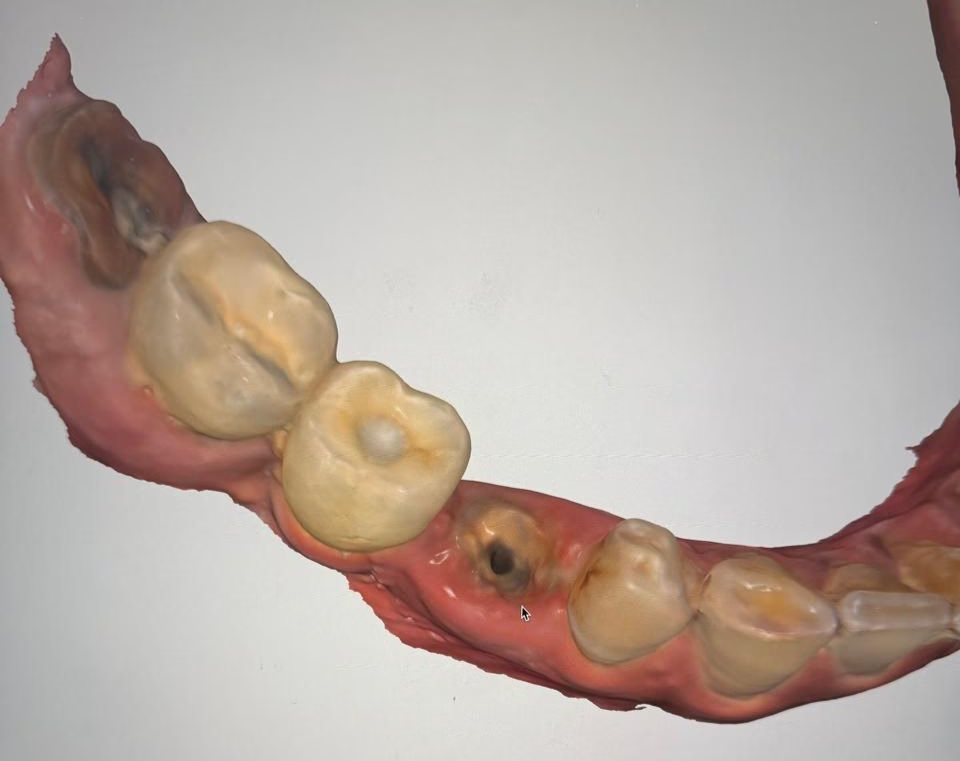
(Scan showing intact root structure)
Although very little of the tooth remained above the gum, the root itself was intact and had adequate length. There were also no periapical changes visible on the X-ray and scan, and the surrounding bone support appeared adequate.
These findings were important.
The question was no longer simply, “How much of the tooth is broken?”
It became:
“Is the remaining root healthy and structurally suitable enough to support a new restoration?”
In this case, the answer appeared to be yes.
The existing root canal treatment meant that the tooth did not need another root canal treatment. Instead, the possibility of using the existing root as the foundation for rebuilding the tooth could be considered.
Of course, preserving the tooth was not presented as a guaranteed outcome. The prognosis was discussed with the patient as guarded, along with the alternative of extraction followed by replacement.
After understanding both approaches, the patient chose to try to preserve the natural tooth.
Why we decided to give the natural tooth a chance
The decision to preserve this tooth was not based simply on a desire to avoid extraction.
There are situations where removing a tooth is the most appropriate and predictable treatment. If a tooth is fractured beyond a point where it can be restored, if the root itself is compromised, if there is inadequate supporting bone, or if the remaining structure cannot reliably support a restoration, trying to save it may only postpone the inevitable.
That is not what we wanted to do here.
The reason this case was different was what we found when we looked beyond the part of the tooth that had broken away.
The visible portion of the tooth was almost completely gone. What remained at the gum level looked, at first, like very little to work with. But the root was intact and sufficiently long. The surrounding bone support was adequate, and there were no periapical changes visible on the X-ray.
Those findings gave us something important: a foundation.
The tooth had already undergone root canal treatment, so our objective was not to repeat that treatment. Instead, the question was whether the existing root could be used to support a new tooth structure above the gum.
We discussed this carefully with the patient.
There were essentially two paths.
The first was to remove the remaining tooth and subsequently replace it with a dental implant or a bridge. This would be a conventional and entirely reasonable approach if the tooth was considered unsalvageable.
The second was more conservative: retain the existing natural root and reconstruct the missing portion of the tooth over it.
The second option also came with uncertainty. We explained that the prognosis was guarded. Preserving a severely damaged tooth is not the same as guaranteeing that it will last indefinitely. The patient needed to understand both the potential benefit and the possibility that the tooth might ultimately require extraction if it could not be maintained.
After discussing these considerations, the patient chose to attempt preservation.
At that point, the treatment was no longer about simply “avoiding an extraction.”
It was about determining whether the remaining natural root could be converted into a stable foundation for a new restoration — and doing so carefully enough that the tooth could return to useful function.
That is where the reconstruction began.
Rebuilding a tooth that had almost disappeared
Reconstructing this tooth was not simply a matter of placing a crown over what was left.
There was very little natural tooth structure visible above the gum, so the first challenge was to create a sound foundation on which the final crown could sit.
The remaining root was therefore prepared carefully. Since the tooth had already undergone root canal treatment, a portion of the existing root canal was used to create space for a post. Care was taken to retain as much of the remaining root structure as possible while creating the space required for the reconstruction.
A customized post and core were then planned.
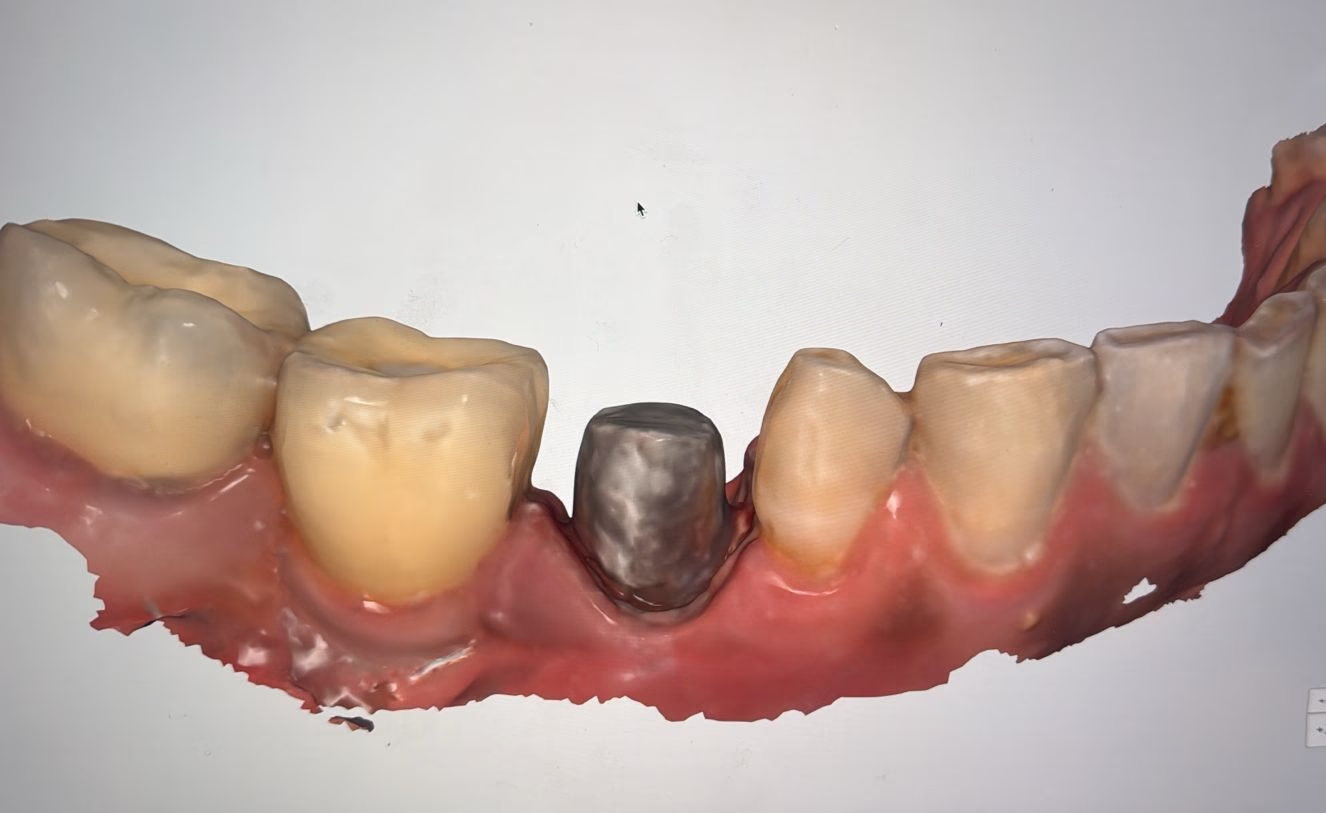
(Post & Core foundation built on the available root structure)
The purpose of the post was not to make the root itself stronger. Rather, it provided a way to create a new foundation extending from the remaining root, allowing the missing portion of the tooth to be reconstructed above the gum.
Instead of relying on a standard, prefabricated shape, we used a digital workflow to capture the relevant dimensions and fabricate a customized post and core. Once ready, it was cemented into the prepared root.
This changed the situation considerably.
What had initially looked like little more than a root stump now had a reconstructed core that could be prepared for the final crown.
Creating the right foundation for the crown
The next consideration was the relationship between the reconstructed tooth and the surrounding gum tissue.
When a tooth has broken down to the gum level, simply rebuilding the visible portion is not enough. The margin of the eventual restoration also needs to be managed carefully in relation to the soft tissues around the tooth.
The remaining tooth structure and the soft tissue were therefore managed to expose an appropriate margin for the restoration.
The tooth was then prepared using the Biologically Oriented Preparation Technique (BOPT) approach.
A further digital scan was taken after the preparation. This allowed the laboratory to use the actual prepared tooth and surrounding contours to design the final restoration rather than relying on a conventional impression.
The crown was then designed and manufactured using a CAD/CAM digital workflow.
Once the crown was ready, it was tried in to assess its fit and relationship with the surrounding tissues and opposing teeth. After the necessary checks, it was cemented onto the reconstructed tooth.
What had started as a tooth with almost no visible crown structure had therefore been rebuilt in stages:
the remaining natural root → a customized post and core → preparation for the final restoration → a full-coverage crown.
The objective throughout was not to disguise how much of the original tooth had been lost.
It was to make use of the natural root that remained and build a functional restoration around it.
And, importantly, this was achieved without extracting the tooth.
The result: the natural tooth was preserved
Once the crown was cemented, the tooth was no longer just a root stump.
It had been reconstructed into a functional tooth that could once again participate in chewing.
The patient was able to use the tooth without the discomfort that had been present before treatment, and the tooth was restored without having to remove the remaining natural root.
For the patient, this meant something quite significant.
Instead of beginning again with an extraction followed by an implant or bridge, the treatment had made it possible to retain the natural tooth structure that was still clinically usable.
Of course, this does not mean that every severely broken tooth can be treated in the same way. This particular outcome was possible because of the specific circumstances of this tooth — including the condition and length of the remaining root, the supporting bone, and the absence of periapical changes on the X-ray.
That distinction is important.
The lesson from this case is not that extraction is unnecessary.
It is that a tooth that looks beyond saving may sometimes deserve a closer clinical assessment before it is removed.
In this case, the examination and X-ray showed that there was still a viable foundation to work with. The patient understood that the prognosis was guarded, considered extraction and replacement as an alternative, and chose to make an attempt to preserve the natural tooth.
And that decision allowed us to rebuild the tooth rather than replace it.
Can a badly broken tooth really be saved?
Sometimes, yes.
But whether a badly broken tooth can be saved cannot be determined reliably from a photograph or simply by looking at how much of the tooth is visible in the mouth.
The important question is whether there is enough healthy, structurally useful tooth remaining — particularly below the level of the break — to support a restoration in a predictable way.
This is why two teeth that look equally badly broken may have completely different treatment options.
One may have a root that is intact, adequate surrounding bone and enough remaining structure to allow the tooth to be rebuilt. Another may have a fracture extending into the root, extensive loss of supporting tissues, or so little sound structure remaining that any attempt at restoration would have a poor prognosis.
What does the dentist look for?
When assessing a severely broken tooth, several factors become important.
The condition of the root
The root is often the most important part of the tooth when very little crown remains. Its length, shape and structural integrity can influence whether it can provide a suitable foundation for a restoration.
The amount of healthy tooth structure remaining
It is not simply a matter of how much tooth is left. The remaining structure needs to be capable of supporting and retaining the planned restoration.
The surrounding bone and tissues
A tooth does not exist in isolation. The health and support of the tissues around its root are important when considering whether preservation is realistic.
The presence of infection or other changes
Clinical examination and appropriate X-rays can reveal problems that may not be apparent from the visible portion of the tooth. Signs of infection, changes around the root or other pathology can significantly affect the treatment decision.
Whether the tooth can be restored predictably
This is perhaps the most important consideration.
The goal should not be to preserve a tooth at any cost. If a tooth can technically be rebuilt but the prognosis is very poor, extraction may ultimately be the more sensible option.
Conversely, if the remaining tooth structure and supporting tissues offer a reasonable foundation, removing the tooth simply because it looks severely damaged may mean giving up on a natural tooth that could potentially have been retained.
That is why the decision is best made after examining the tooth, studying the appropriate X-rays and considering the patient’s individual circumstances.
The case described above is a good example.
Very little of the visible tooth remained, and several dentists had recommended extraction. But the root was intact, sufficiently long, and supported by adequate surrounding bone, with no periapical changes visible on the X-ray. Those findings changed the conversation from “How do we replace this tooth?” to “Can we reasonably rebuild what is still there?”
Sometimes, that is the question worth asking before an extraction is carried out.
When is tooth extraction actually the right choice?
Preserving a natural tooth is valuable, but preservation should never become the goal at any cost.
There are teeth that cannot be saved predictably. In such situations, recommending extraction is not a failure of conservative dentistry. It is often the more responsible treatment decision.
The challenge is knowing the difference between a tooth that is severely damaged but potentially restorable and one where attempting to preserve it is unlikely to provide a satisfactory or durable result.
Extraction may become the more appropriate option when the tooth or its supporting structures have been compromised beyond what can be predictably restored.
For example, a tooth may have:
- a fracture extending into the root that makes restoration unreliable
- insufficient sound tooth structure remaining to support a restoration
- severe loss of the bone or tissues supporting the tooth
- extensive or persistent infection that cannot be predictably managed
- structural damage that makes a stable restoration impractical
- a prognosis so poor that repeated attempts to preserve the tooth would only delay the inevitable
The exact decision depends on the individual tooth and the findings from a clinical examination and appropriate imaging.
This is why I would be cautious about both extremes.
“This tooth definitely needs extraction” may be too quick a conclusion when the remaining root and supporting tissues have not been properly assessed.
But “every natural tooth should be saved” is equally inappropriate.
The objective is not simply to avoid extraction.
The objective is to choose the treatment that gives the patient the most reasonable balance of predictability, function, biological health and long-term outlook.
Sometimes that means rebuilding the natural tooth.
Sometimes it means removing it and replacing it.
What matters is that the decision is made because the tooth’s actual condition warrants it — not simply because the visible part of the tooth looks badly damaged.
That distinction was particularly important in the case described above.
The tooth looked almost completely lost above the gum. But once we assessed what remained underneath, there was enough of a foundation to consider preservation.
And that is why, before agreeing to an extraction, it can be worthwhile to understand what exactly makes the tooth unsalvageable in your particular case.
If the tooth really cannot be saved, what happens next?
If an examination shows that a tooth cannot be restored predictably, extraction may be the appropriate treatment. But even then, the decision does not end with removing the tooth.
The missing tooth will usually need to be considered as part of a broader treatment plan — particularly if it is important for chewing, appearance or maintaining the function of the surrounding teeth.
Depending on the individual situation, the space can generally be replaced with a dental implant, a bridge or a removable partial denture.
A dental implant replaces the missing tooth’s root with an artificial implant, which can then support a crown. An implant may be an excellent option in an appropriate patient, but it involves its own assessment, planning, healing and restorative stages.
A bridge uses the teeth adjacent to the missing tooth to support a replacement tooth. Whether this is suitable depends on the condition and position of the neighbouring teeth, among other factors.
A removable partial denture is another option in selected situations, particularly when multiple teeth are missing or when a removable solution is more appropriate for the patient.
There is therefore no single replacement that is automatically right for everyone.
The important point is that extraction and replacement should be considered together as part of the overall treatment plan.
This is also why, when a natural tooth has a reasonable possibility of being preserved, it can be worth discussing that possibility before proceeding directly to extraction.
Preserving the tooth may avoid the need for a replacement altogether.
But when preservation is not predictable, the focus should shift from trying to save an unsalvageable tooth to planning the most appropriate way to restore function and oral health after extraction.
The right decision is ultimately the one that makes sense for that particular tooth, that particular mouth and that particular patient.
Should you get a second opinion before tooth extraction?
If you have been told that a tooth needs to be extracted, it is reasonable to ask questions before making that decision.
This does not mean that the first dentist is necessarily wrong. In many cases, extraction is the appropriate treatment. But if you are unsure, particularly when you have been told that the tooth is “too broken” or “cannot be saved,” a second opinion can help you understand why.
A useful second opinion should not simply give you a different answer.
It should give you a better understanding of the tooth.
The dentist should be able to explain what the clinical examination and X-rays show, what remains of the tooth, whether the root is intact, whether there is adequate supporting bone, and whether there is enough healthy structure to support a restoration.
Just as importantly, you should understand the prognosis.
If an attempt is made to preserve the tooth, how predictable is that treatment? What are the limitations? What could happen if the tooth does not respond as hoped? And if extraction is recommended, why is preservation considered unsuitable?
These are more useful questions than simply asking:
“Can you save my tooth?”
A responsible answer may sometimes be yes, sometimes no, and sometimes “we need to investigate further.”
What should you take for a second opinion?
If you decide to seek another opinion, take your existing dental records and X-rays with you whenever possible. They can provide useful information and may prevent unnecessary repeat investigations.
It is also helpful to ask the dentist to explain the options in terms you can understand.
You should leave the consultation knowing:
- why extraction has been recommended
- whether the tooth has been assessed for possible preservation
- what makes the tooth restorable or non-restorable
- what the prognosis would be if you attempted to save it
- what treatment would be required to preserve it
- and what the alternatives would be if extraction is ultimately necessary
The purpose of a second opinion is therefore not to find a dentist who will promise to save the tooth.
It is to make sure you understand the condition of the tooth well enough to make an informed decision.
In the case described in this article, that distinction mattered. The patient had already received consistent recommendations for extraction. A closer assessment showed that the remaining root and supporting structures offered another possibility — although with a guarded prognosis.
The patient was then able to make that decision with a clear understanding of both paths.
Before removing a natural tooth, understanding why it cannot be predictably saved is often worth the time.
What should you ask before agreeing to a tooth extraction?
If you have been advised to have a tooth extracted, you do not need to make the decision without understanding what is happening.
You can ask your dentist to explain the reasoning in straightforward terms.
Here are some questions that can help you have a more useful conversation:
1. Why does this tooth need to be extracted?
Ask what specific finding makes the tooth unsuitable for preservation. “The tooth is badly broken” may describe what you can see, but it does not necessarily explain what is happening beneath the gum.
2. Is the root intact?
When much of the visible tooth has been lost, the condition of the remaining root becomes particularly important.
3. Is there enough healthy tooth structure left to restore it?
A tooth may look severely damaged but still have usable structure. Equally, there may be too little sound structure to support a predictable restoration.
4. What does the X-ray show?
Ask your dentist to show you the X-ray and explain what they see. The condition of the root, surrounding bone and tissues can influence whether preservation is realistic.
5. If we try to save it, what would the treatment involve?
Understanding the treatment required helps you compare preservation with extraction and replacement on an informed basis.
6. What is the prognosis if we try to save the tooth?
This is an especially important question.
Saving a tooth is not simply about whether it can technically be rebuilt. Ask how predictable the proposed treatment is and what limitations or risks you should understand.
7. What happens if the attempt to save it is unsuccessful?
A responsible treatment plan should also consider the alternative. Knowing what would happen if preservation does not work can make the decision much clearer.
8. If it needs to be extracted, what are my replacement options?
Ask about the alternatives available in your particular situation — such as an implant, bridge or removable partial denture — and why one may be more appropriate than another.
You do not need to know the dental terminology before having this conversation.
What matters is that you understand why extraction is being recommended, whether preservation has been properly considered, what the prognosis is, and what your alternatives are.
Sometimes, that conversation confirms that extraction is the right decision.
And sometimes, as this case demonstrates, it reveals that there may still be a reasonable opportunity to preserve the natural tooth.
Why preserving a natural tooth can be worth considering
When a tooth can be preserved with a reasonably predictable prognosis, keeping the natural tooth can have meaningful advantages.
A natural tooth is part of a living biological system. It is held in place by the tissues surrounding its root and functions together with the neighbouring teeth and supporting structures. When the tooth can be retained, we are able to work with that existing biological foundation rather than first removing it and then planning how to replace what has been lost.
This does not mean that a dental implant is a poor treatment.
Implants have an important and well-established role in replacing missing teeth, and for a tooth that genuinely cannot be saved, an implant may be an excellent option. The same applies to bridges and other forms of tooth replacement in appropriately selected situations.
The distinction is simply this:
If a natural tooth can be reasonably and predictably restored, it is worth asking whether it needs to be removed in the first place.
Preserving a tooth can mean avoiding an extraction and the subsequent treatment required to replace it. It also means retaining the patient’s own tooth rather than removing it and introducing an artificial replacement.
But preservation should always be considered in the context of prognosis.
There is little benefit in keeping a tooth temporarily if the remaining structure is incapable of supporting a predictable restoration, or if the biological conditions around it are unfavourable. Repeated treatment on a tooth with a very poor prognosis can eventually become more complicated, costly and frustrating for the patient.
That is why conservative dentistry is not simply about doing less treatment.
It is about doing only the treatment that is justified by the condition of the tooth.
Sometimes the most conservative decision is to restore and retain the natural tooth.
Sometimes the most conservative decision, from the patient’s long-term perspective, is to remove a tooth that genuinely cannot be maintained predictably and replace it appropriately.
The skill lies in making that distinction.
In the case described earlier, the natural root still provided a usable foundation. Rather than removing it automatically because the visible crown had been lost, we assessed whether that foundation could be used to reconstruct the tooth.
In this particular case, it could.
That is why I believe that when extraction has been recommended, the conversation should include one simple question:
“Is there a reasonable and predictable way to preserve this tooth?”
If the answer is no, extraction can be the right treatment.
And if the answer is yes, that possibility deserves to be considered before the natural tooth is removed.
If you have been told your tooth cannot be saved
Being told that a tooth cannot be saved can leave you with very little time to process what you have just been told.
The recommendation may come with an immediate treatment plan: extract the tooth, allow the area to heal, and then consider an implant or bridge.
Sometimes, that is exactly the right sequence.
But if you are uncertain about the recommendation, it is reasonable to pause and understand the diagnosis before making an irreversible decision.
Ask what, specifically, makes the tooth unsuitable for preservation.
Is there a fracture in the root? Is there too little healthy tooth structure remaining? What is the status of the supporting bone – is it severely compromised? Is there an infections or another problem that cannot be predictably treated? Or is the tooth simply very badly broken above the gum?
Those are very different situations.
A tooth that is badly broken may look alarming, but appearance alone does not tell us whether the remaining root can be used.
That is why, when a patient comes to me after being advised extraction, I prefer to first understand the tooth that remains, rather than make a decision based only on the tooth that has been lost.
That means examining the tooth carefully, reviewing the appropriate X-rays and considering whether there is enough sound structure and supporting tissue to make preservation a reasonable option.
And sometimes, after doing that assessment, the conclusion is still that the tooth should be extracted.
That is an important outcome too.
The purpose of a conservative approach is not to promise that every tooth can be saved. It is to make sure that a tooth is not removed simply because it looks difficult to restore, when there may still be a reasonable way to preserve it.
The case in this article was one such situation.
The patient had already heard the same recommendation from several clinics. Extraction followed by replacement appeared to be the straightforward path. But the examination and X-ray revealed that the remaining root was intact, sufficiently long and supported by adequate bone.
That did not make preservation guaranteed.
It made preservation worth considering.
And after discussing the guarded prognosis and the alternative of extraction and replacement, the patient chose to try to retain the natural tooth.
That is ultimately what a good treatment decision should allow a patient to do: understand the choices, understand the uncertainty, and then make an informed decision about their own tooth.
A final thought, as I see the cases
When a tooth is badly damaged, it is understandable to assume that extraction is the only realistic option.
As dentists, however, we have to look beyond what is immediately visible.
The question I ask is not simply, “How much of the tooth is left?” It is, “What is the condition of what remains, and can it support a predictable restoration?”
That distinction can sometimes change the treatment plan completely.
The case discussed in this article is a good example. Very little of the visible tooth remained, and extraction had already been recommended. But the remaining root was intact and sufficiently long, the surrounding bone support was adequate, and there were no periapical changes visible on the X-ray.
Those findings gave us a reason to consider preservation.
At the same time, I would never want a patient to interpret this as a promise that a severely broken tooth can always be saved. Every tooth is different. Sometimes the most responsible treatment is extraction.
My approach is therefore quite simple:
If a natural tooth can be reasonably and predictably preserved, I believe that option deserves to be considered. If it cannot, I believe the patient should be told clearly why — and helped to choose the most appropriate replacement option.
For me, conservative dentistry is not about avoiding treatment.
It is about avoiding unnecessary treatment, while being honest about what is and is not realistically possible.
And when a patient is facing an irreversible decision such as extraction, I believe they deserve to understand that distinction before making it.
Frequently asked questions about extractions
Sometimes, yes. A badly broken tooth may still be restorable if the remaining root and tooth structure are suitable, the surrounding tissues provide adequate support, and the tooth can be restored with a reasonably predictable prognosis.
The visible amount of tooth remaining is not enough to determine this. A clinical examination and appropriate X-rays are important before deciding whether extraction is necessary.
A tooth broken close to or at the gum line may sometimes be rebuilt, but it depends on what remains beneath the gum.
The condition of the root, the amount of sound tooth structure, the surrounding bone and tissues, and the ability to create a stable restoration all need to be assessed. In some cases, preservation is possible; in others, extraction may be the more predictable option.
No. Losing most of the visible crown does not automatically mean that the entire tooth is unsalvageable.
If the remaining root is intact and there is adequate supporting tissue and sufficient structure to support a restoration, preserving the tooth may sometimes be considered.
However, the prognosis needs to be assessed on an individual basis.
If you are uncertain about an extraction recommendation, getting a second opinion can be reasonable, particularly when the tooth is being described as “too broken to save.”
The purpose of a second opinion should not be to find someone who will promise to save the tooth. It should help you understand why extraction has been recommended, whether preservation has been considered, what the prognosis would be, and what your alternatives are.
Sometimes. A root canal treated tooth can occasionally be rebuilt even when a substantial portion of the crown has been lost, provided the remaining root and tooth structure are suitable for restoration.
In the case described in this article, the tooth had already undergone root canal treatment, and the remaining root provided a foundation that could be used for reconstruction.
That does not mean every root canal treated tooth with a broken crown can be saved. The condition of the individual tooth needs to be assessed.
If a tooth cannot be restored predictably, extraction may be the appropriate treatment. The missing tooth can then be considered for replacement with options such as a dental implant, bridge or removable partial denture, depending on the individual circumstances.
The important thing is to understand why preservation is not considered predictable before proceeding with extraction.
There is no universal answer.
A dental implant can be an excellent way to replace a tooth that genuinely cannot be saved. But if a natural tooth can be reasonably and predictably restored, it is worth considering whether extraction and replacement are necessary in the first place.
The decision should be based on the condition and prognosis of the individual tooth, rather than on the assumption that either preservation or an implant is always better.
The only reliable way to answer that is through an appropriate dental examination and assessment of the tooth, usually including X-rays.
The dentist will need to evaluate the remaining tooth structure, root, surrounding bone and tissues, any infection or other pathology, and whether the proposed restoration can be supported predictably.
If you have been advised to have a tooth extracted and are unsure about the recommendation, a detailed assessment can help you understand your options before making an irreversible decision.
If you have been advised to have a tooth extracted
So, if you have been told that a tooth needs to be extracted and you are unsure whether it can be saved, it is reasonable to understand the diagnosis before making that decision.
At The Dentist, we assess the individual tooth, review the appropriate X-rays and discuss the treatment options with the patient — including preservation when it offers a reasonable and predictable possibility, and extraction when it does not.
There is no promise that every tooth can be saved.
But if preserving your natural tooth is important to you, we can help you understand whether that is a realistic option in your particular case.
You can contact The Dentist to arrange a consultation or discuss your case with our team.
If you are visiting Delhi from overseas or are currently outside India, you can also contact us to discuss your dental concerns and explore whether an initial remote consultation would be appropriate before planning an in-person visit.