

Dr Srishti Jauhar, Dentist & Clinical Director, The Dentist — 23+ years of clinical experience; 4,500+ root canal treatments; Fellowship in Rotary Endodontics (IARE, USA). She follows an ethical, conservative and patient-first approach, with a strong focus on preserving natural teeth whenever reasonably possible. Through these articles, she shares her clinical experience to help patients better understand their dental problems and treatment options, and make informed decisions about their care.
A deep cavity does not always mean a root canal is necessary. Here’s how two badly decayed upper molars were restored using different minimally invasive approaches, preserving their natural tooth structure without root canal treatment.
In this article:
A deep cavity does not automatically mean a root canal
What happens when a cavity becomes very deep?
Does every deep cavity need a root canal?
How dentists determine whether a deep cavity can be saved
The real case: How we restored two deeply decayed molars without root canal treatment
What are IDS, DME and the Bioclear Injectable Technique?
Deep cavity treatment: Filling, onlay or root canal — what is the difference?
What are the signs that a deep cavity may need urgent dental attention?
Can a tooth with deep decay remain healthy after treatment?
Considering treatment for a deep cavity? Start with the right diagnosis
A deep cavity does not automatically mean a root canal
When patients are told that they have a deep cavity, one of their first concerns is often whether the tooth will need a root canal. This is understandable.
Deep decay can look alarming, particularly when it affects a back tooth, and many people assume that once a cavity reaches close to the nerve, root canal treatment is inevitable.
However, that is not always the case.
As a dentist, I believe that the first step is to understand the actual condition of the tooth rather than decide on treatment based on how deep or extensive a cavity appears.
The health of the dental pulp, the response of the tooth to clinical tests, the amount of healthy tooth structure remaining, and the possibility of restoring it reliably all matter when making this decision.
I recently came across a case that illustrates this particularly well. A patient came in with pain and food getting stuck around two upper-left back teeth. On examination and dental X-rays, both molars showed extensive, deep decay. Yet, the initial cold tests showed a positive response in both teeth.
After assessing the findings, two different restorative approaches were planned. One tooth was restored directly using composite with the Bioclear Injectable Technique. The other required additional steps, including Immediate Dentin Sealing (IDS) and Deep Margin Elevation (DME), followed by a bonded indirect onlay to provide additional protection.
Both teeth were restored without root canal treatment.
What makes this case important is not simply that root canal treatment was avoided. It demonstrates why I do not consider two deeply decayed teeth identical, or assume that every extensive cavity requires the same treatment.
My approach is to preserve natural tooth structure wherever it is clinically appropriate and predictable, while ensuring that the restored tooth has the support and protection it needs.
In this article, I will explain how I assess a deep cavity, what determines whether a tooth can be saved without root canal treatment, and how two teeth in this case were restored using different conservative adhesive techniques.
What happens when a cavity becomes very deep?
To understand why a deep cavity does not always require a root canal, it helps to understand the basic structure of a tooth and what happens as tooth decay progresses.
A tooth is made up of different layers. Each layer has a role, and the depth to which decay has progressed can influence the treatment required.
How does tooth decay progress?
The outermost layer of a tooth is the enamel. It is the hard, protective covering that shields the tooth from everyday wear and damage.
Beneath the enamel is the dentin. It is softer and contains microscopic channels called dentinal tubules. As decay moves through the enamel and reaches the dentin, it can progress more quickly because dentin is less resistant to bacterial damage.
This is why a cavity that initially appears small on the surface may be much larger underneath.
When decay continues deeper into the tooth, it can approach the dental pulp. At this stage, we are dealing with what is commonly described as a deep cavity in a tooth or deep tooth decay.
What is the dental pulp, and why does it matter?
The dental pulp is the soft tissue located inside the tooth. It contains nerves, blood vessels and connective tissue that help nourish the tooth and respond to external stimuli.
Patients often refer to the pulp as the tooth’s nerve, although it is more than just a nerve.
The condition of this tissue is particularly important when deciding whether a deep cavity can be treated with a filling or another restoration, or whether root canal treatment is necessary.
What happens when decay gets close to the pulp?
When deep tooth decay approaches the pulp, bacteria and the products of bacterial activity can irritate the tissue inside the tooth. This may cause inflammation, which can sometimes produce sensitivity or pain.
However, a cavity close to the nerve does not automatically mean that the pulp is irreversibly damaged.
In some cases, the pulp may still be healthy or capable of recovering after the source of irritation is carefully removed and the tooth is properly sealed. In other cases, the inflammation may be too advanced, or the pulp may already be irreversibly damaged or infected, making root canal treatment necessary.
This distinction is important. The aim is not simply to remove the decay, but to assess how the pulp has responded and determine whether the remaining tooth can be restored reliably.
That is why I do not decide whether a tooth needs a root canal based on the apparent depth of the cavity alone. A clinical examination, appropriate diagnostic tests and dental X-rays help me understand what is happening beneath the visible surface.
Does every deep cavity need a root canal?
No. A deep cavity does not automatically mean that a root canal is necessary.
This is one of the most common concerns I hear from patients who have been told that tooth decay has reached close to the nerve. While some deeply decayed teeth do need root canal treatment, others may still be treated with a conservative restoration that preserves the dental pulp.
The important distinction is whether the pulp inside the tooth is healthy, inflamed but capable of recovery, or irreversibly damaged or infected. The amount of healthy tooth structure remaining also influences whether the tooth can be restored successfully.
When can a deep cavity be treated without a root canal?
A tooth with deep decay may be suitable for treatment without root canal therapy when the pulp is still healthy or its inflammation is considered reversible, and the tooth can be restored reliably.
Depending on the clinical findings, treatment may involve carefully removing the decayed tooth structure, protecting the remaining dentin where appropriate, and sealing the cavity with a well-bonded restoration.
The objective is to remove the source of bacterial irritation while preserving as much healthy tooth structure as possible.
In selected cases, even when the decay is extremely close to the pulp, techniques that aim to preserve the pulp may be considered. The choice depends on the pulp diagnosis and what is found during treatment.
However, avoiding a root canal should never become the objective at the expense of the tooth’s long-term health. The treatment must be appropriate for the condition of that particular tooth.
When is root canal treatment necessary?
Root canal treatment is generally recommended when the dental pulp has become irreversibly inflamed or infected and cannot be predictably maintained.
This may happen when deep tooth decay has allowed bacteria to reach the pulp, or when the tooth has sustained damage from trauma, cracks or repeated dental procedures.
Symptoms such as spontaneous toothache, pain that lingers after exposure to hot or cold, or pain that disturbs sleep can raise concern about significant pulp inflammation. However, symptoms alone are not enough to establish the diagnosis.
When root canal treatment is necessary, it is not a treatment failure. It is a well-established way of removing diseased pulp tissue, cleaning and sealing the root canal system, and retaining a natural tooth that might otherwise need extraction.
My responsibility is to explain why a particular treatment is indicated, rather than recommend or avoid a root canal simply as a matter of preference.
Can a tooth look badly damaged but still be saved?
Yes, sometimes a tooth with extensive visible decay can still be restored.
The visible size of a cavity does not always tell us whether the pulp is irreversibly damaged or whether enough healthy tooth structure remains to rebuild the tooth.
I look at several factors before deciding whether a deeply decayed tooth can be saved. These include the condition of the pulp, the extent and location of decay, whether the tooth has cracks, how much sound tooth structure remains, and whether a predictable restoration can be achieved.
In some situations, a tooth may not need root canal treatment but may require more than an ordinary filling. An onlay or another form of cuspal coverage may be needed to protect the remaining tooth structure.
This is why two teeth with similarly deep cavities can require different treatments.
The decision is not simply about how deep the cavity is. It is about whether the pulp can be maintained and whether the tooth can be restored predictably.
Sometimes, a tooth may need a root canal even when it does not cause pain.
How dentists determine whether a deep cavity can be saved
When I examine a patient with a deep cavity, I do not make a treatment decision based on the size of the cavity alone. I need to understand how far the decay has progressed, whether the pulp inside the tooth is affected, and whether enough healthy tooth structure remains to restore it.
There is no single test that can answer all these questions. I combine the patient’s symptoms, clinical examination, dental X-rays and appropriate pulp tests to arrive at a diagnosis.
Here is what I look for.
Clinical examination of the tooth
I begin by understanding what the patient has been experiencing.
Then I ask about the nature of the pain, when it started, how long it lasts, and whether it occurs spontaneously or in response to hot, cold or sweet foods. I also want to know whether the discomfort is affecting sleep, chewing or everyday activities.
I then examine the tooth to assess the visible decay, the condition of the surrounding gums, any existing fillings or restorations, and whether there are signs of cracks or damage.
The amount and location of the remaining healthy tooth structure are particularly important. Even if the pulp can be preserved, the tooth must still be capable of supporting a reliable restoration.
Why dental X-rays are important for a deep cavity
A dental X-ray helps me assess how far the decay has progressed beneath the visible tooth surface.
It can show the approximate depth of the cavity, how close the decay is to the pulp chamber, and whether there are changes around the root that may indicate disease affecting the surrounding tissues.
This information is important because a cavity can look relatively small when viewed directly but extend much deeper inside the tooth.
However, an X-ray does not tell me everything about the condition of the pulp. It needs to be interpreted alongside the clinical examination and other diagnostic findings.
What does a cold test tell the dentist?
A cold test is one of the important diagnostic tests I use when assessing a tooth with deep decay.
During this test, I apply a controlled cold stimulus to the tooth and observe how it responds. I also compare the response with neighbouring or similar healthy teeth.
A brief response that settles quickly may be consistent with a normal pulp response or a less severe inflammatory condition. An exaggerated response that continues after the cold stimulus is removed can raise concern about more significant pulp inflammation.
A tooth that does not respond may also require further investigation.
It is important to understand that a cold test measures the sensory response of the pulp; it does not directly measure its blood supply or establish its complete health. Therefore, a positive response does not automatically mean that the tooth will never need root canal treatment.
Why symptoms alone may not tell the whole story
Two patients with similarly deep cavities may describe very different symptoms. Equally, a tooth that appears badly decayed may still show a reassuring response during diagnostic testing.
This is why I avoid making a decision based only on whether a patient has pain or how severe that pain feels.
The history of symptoms, clinical findings, X-ray appearance and pulp test responses need to be considered together. In certain situations, additional information during the treatment itself may also influence the final decision.
My aim is to establish whether the pulp can be preserved and whether the remaining tooth can be restored predictably. Only after understanding both can I recommend the most appropriate treatment, whether that is a direct filling, an adhesive restoration, an onlay or root canal treatment followed by a suitable restoration.
The real case: How we restored two deeply decayed molars without root canal treatment
A patient came to us with a concern that many people experience: discomfort in the back teeth, along with food repeatedly getting stuck in the affected area.
On examination, we found deep decay in two upper-left molars — teeth 26 and 27. Dental X-rays confirmed that the cavities extended deep into the tooth structure.
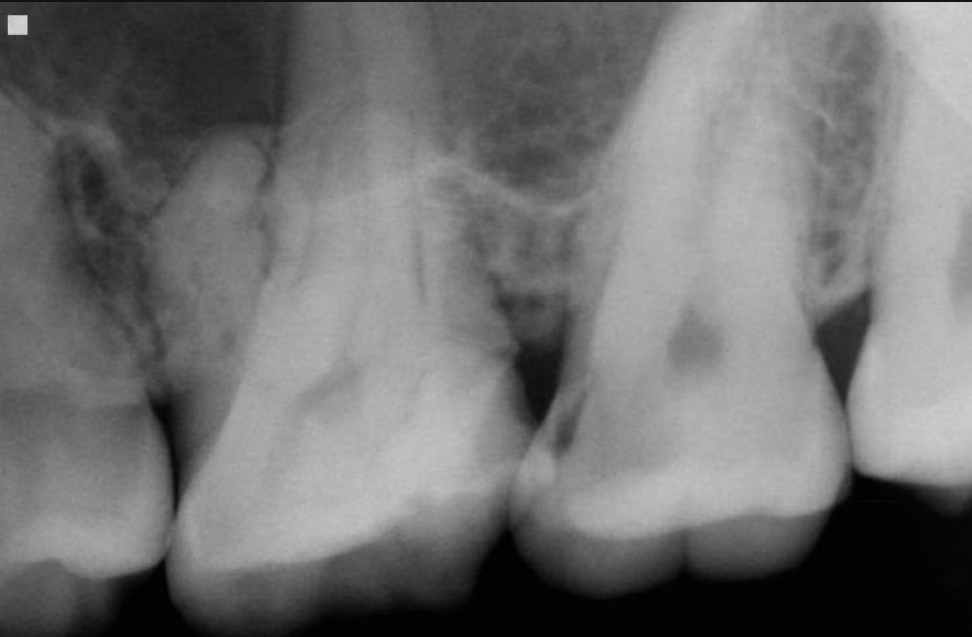
(Pre-operative dental X-rays showing extensive decay in the upper-left first and second molars (26 and 27))
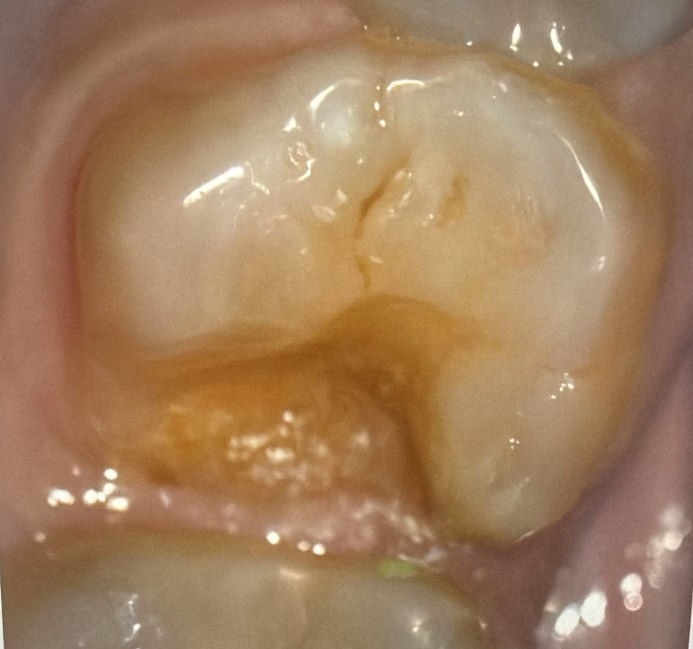
(Pre-operative intraoral photograph showing the two affected upper-left molars before restorative treatment)
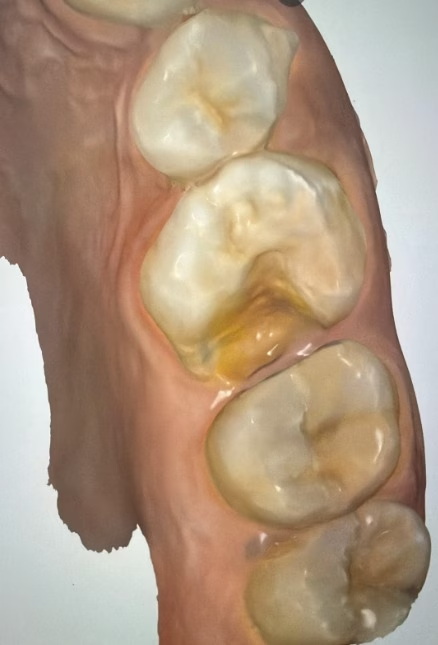
(Pre-operative digital intraoral scan documenting the condition of the teeth before restorative preparation)
Given the extent of decay, it was important to establish whether the pulp inside either tooth was affected and whether both teeth could be restored without root canal treatment.
The initial cold tests showed a positive response in both teeth. This was a useful part of the diagnostic assessment, although it was not, by itself, a guarantee of long-term pulp health.
After evaluating the findings, we planned to preserve both teeth using adhesive restorative techniques. Interestingly, although the two teeth had similarly deep decay, they required different restorative approaches.
What was the treatment objective?
The objective was to preserve as much healthy natural tooth structure as reasonably possible, manage the deep decay, seal the restored areas effectively and protect the remaining tooth structure.
We followed a conservative, adhesive approach rather than automatically opting for root canal treatment or a more extensive restoration.
The treatment plan was based on the individual requirements of each tooth.
Tooth 27: Restoring the deep cavity with composite
For tooth 27, we used a biomimetic adhesive approach and restored the tooth with composite using the Bioclear Injectable Technique.
This technique allowed us to rebuild the affected tooth structure using a direct composite restoration.
The aim was to restore the tooth while preserving the remaining healthy structure and achieving an effective seal.
Tooth 26: Why this tooth needed an indirect onlay
Tooth 26 required a different approach because of the restorative requirements of the remaining tooth structure.
The treatment involved several steps:
Immediate Dentin Sealing (IDS): After preparing the tooth, IDS was used to seal the exposed dentin. This is an important step in adhesive restorative treatment.
Deep Margin Elevation (DME): DME was carried out to manage the deep restorative margin and establish a more suitable margin for the subsequent adhesive restoration.
Composite restoration: Composite was placed using the Bioclear Injectable Technique as part of the restorative procedure.
Intraoral scanning: Once the preparation was ready, an intraoral scan was taken to record the prepared tooth for the indirect restoration.
Bonded indirect onlay: The final restoration was an indirect onlay, which was bonded to the tooth using adhesive protocols. This provided additional protection to the remaining tooth structure.
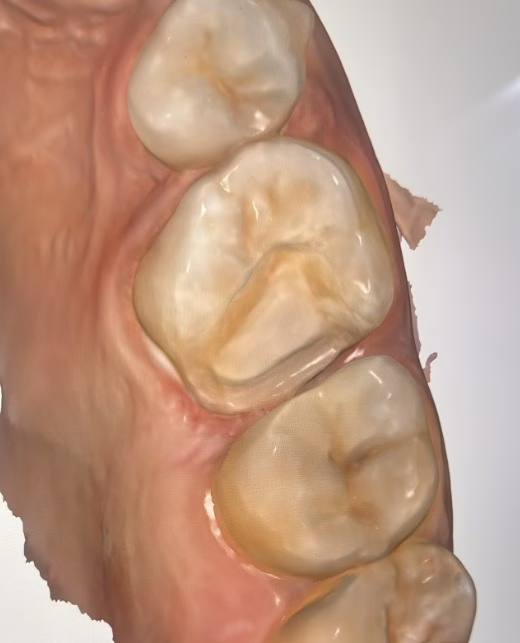
(Digital intraoral scan after preparation of tooth 26, documenting the prepared tooth for fabrication of the indirect onlay)
Unlike a direct filling, an indirect onlay is fabricated separately and then bonded to the prepared tooth. It can be particularly useful when a molar needs additional protection beyond what a conventional filling can provide.
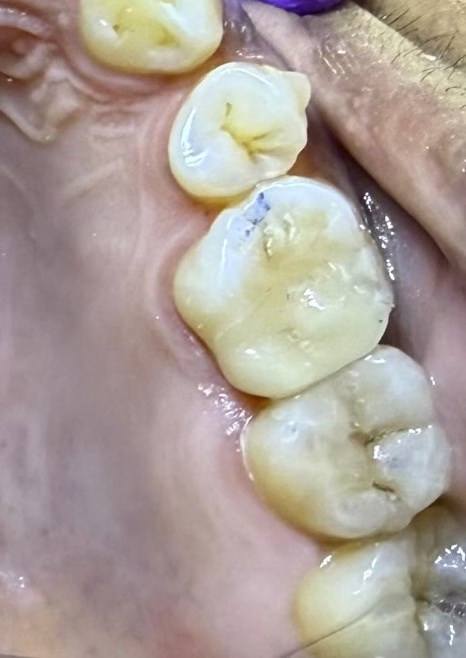
(Final intraoral photograph showing the bonded indirect onlay on tooth 26 after restorative treatment)
How did the teeth respond after treatment?
At the follow-up visit, the patient was happy with the treatment outcome. There was no pain, and the earlier problem of food getting lodged around the treated teeth had resolved.
Most importantly, both deeply decayed molars had been restored without root canal treatment.
This case demonstrates why the treatment of a deep cavity in a tooth should never be decided by its appearance alone. Even two neighbouring teeth with extensive decay may need different restorative solutions.
The right approach is to assess each tooth individually, understand the condition of its pulp, and choose a restoration that addresses its structural requirements while preserving natural tooth tissue wherever possible.
Another case where a tooth was restored while preserving its natural pulp.
What are IDS, DME and the Bioclear Injectable Technique?
Some deep cavities can be restored with a conventional filling. Others need a more carefully planned adhesive approach, particularly when the decay extends towards the gum line or a significant amount of tooth structure has been lost.
In the case discussed above, we used three restorative techniques: Immediate Dentin Sealing (IDS), Deep Margin Elevation (DME) and the Bioclear Injectable Technique.
Let me explain what each involves and why these techniques can be useful when restoring a deeply decayed tooth.
What is Immediate Dentin Sealing (IDS)?
Immediate Dentin Sealing, commonly called IDS, is an adhesive technique in which the exposed dentin is sealed with a bonding system immediately after tooth preparation.
When a tooth is prepared for an indirect restoration, such as an onlay, some of its dentin becomes exposed. Rather than waiting until the final restoration is ready, IDS allows this exposed dentin to be sealed at the preparation stage.
The purpose is to protect the prepared dentin from contamination and establish an adhesive surface for the subsequent bonding procedure.
In our case, IDS was used on tooth 26 as part of the preparation for its indirect onlay. It was one of the steps in creating a suitable foundation for the final bonded restoration.
What is Deep Margin Elevation (DME)?
Deep Margin Elevation, or DME, is a restorative technique used when a cavity extends deep towards or below the gum line, particularly around the sides of a tooth.
A deep cavity margin can be difficult to access, isolate, scan or restore accurately. DME involves using an adhesive restorative material, commonly composite resin, to raise the deep margin to a more accessible position.
This can make subsequent restorative procedures, including the placement and bonding of an indirect onlay, more manageable.
However, DME is not suitable for every deep cavity. The dentist must assess the position of the margin, the surrounding gum and supporting tissues, and whether adequate isolation and sealing can be achieved.
In tooth 26, DME was used to manage the deep margin before proceeding with the indirect restoration.
What is the Bioclear Injectable Technique?
The Bioclear Method is an approach to composite dentistry that uses specially designed transparent anatomical matrices and an injection-moulding technique to shape composite material around the prepared tooth.
Instead of simply placing composite into a cavity in conventional increments, the technique uses the matrix to help form the restoration’s intended shape and contours.
The composite is adapted within this anatomical form, allowing the dentist to rebuild the missing tooth structure and establish appropriate contact and contours.
In our case, the Bioclear Injectable Technique was used for the direct composite restoration of tooth 27. Composite using this technique was also part of the restorative procedure for tooth 26 before its final onlay.
The technique is not a substitute for proper diagnosis, cavity preparation or adhesive protocols. Its suitability depends on the tooth, the extent of damage and the restoration being planned.
What is an indirect onlay, and why might a tooth need one?
An onlay is a type of indirect dental restoration that is fabricated outside the mouth and subsequently bonded to the prepared tooth.
Unlike a conventional filling, which is placed directly into the cavity, an indirect onlay is designed to cover and restore a larger portion of the tooth. Depending on the preparation, it can also cover one or more weakened chewing surfaces, known as cusps.
This additional coverage can be important when a back tooth has lost considerable structure due to deep decay. A large conventional filling may not provide the protection that the remaining tooth needs.
An onlay can therefore be considered when the objective is to restore the tooth’s shape and function while providing support to the remaining structure.
For tooth 26, we used a bonded indirect onlay because its restorative requirements called for additional protection. An intraoral scan was taken after preparation to record the tooth for fabrication of the final restoration.
The important point is that these techniques serve different purposes. IDS helps seal prepared dentin, DME helps manage deep restorative margins, the Bioclear technique helps shape direct composite restorations, and an onlay provides coverage and protection where the remaining tooth structure requires it.
They are not treatments that every patient with a deep cavity will need. The choice depends on the condition of the individual tooth and the restoration required.
Deep cavity treatment: Filling, onlay or root canal – what’s the difference?
When a tooth has a deep cavity, the treatment decision is not simply about removing the decay and filling the space. I also need to consider how much healthy tooth structure remains, how close the decay is to the dental pulp, and whether the restored tooth will be strong enough to withstand everyday chewing forces.
Depending on these findings, deep cavity treatment may involve a direct filling, an indirect restoration such as an onlay, or root canal treatment followed by an appropriate restoration.
These treatments serve different purposes. The choice depends on the condition of the individual tooth.
When is a deep cavity filling enough?
A direct composite filling may be suitable when the decay can be removed, the remaining tooth structure is sufficiently strong, and the cavity can be sealed reliably.
With a deep cavity filling, the decayed portion is removed and the prepared area is restored using a tooth-coloured composite material. Modern adhesive techniques allow the restoration to bond to the remaining tooth structure.
However, the size of the cavity matters. A tooth may have enough healthy structure to support a filling even when the decay is deep. In another tooth, extensive decay may leave the remaining walls or cusps too weak to withstand chewing pressure reliably.
That is why I do not decide on a filling simply because the tooth can be filled. I also consider how well it is likely to function over time.
When might an onlay be recommended for a damaged molar?
An onlay may be appropriate when a significant amount of tooth structure has been lost and one or more cusps need additional protection.
Unlike a conventional filling, which restores the prepared cavity directly, an onlay is made outside the mouth and then bonded to the tooth. It can restore the damaged portion while covering and protecting weakened cusps.
For some teeth, this provides a way to reinforce the remaining structure without covering the entire tooth with a full crown. Whether an onlay is suitable depends on the extent and location of the damage, the amount of sound tooth structure available, and whether a reliable adhesive bond can be achieved.
In the case discussed earlier, the two upper-left molars had different amounts and patterns of structural damage. One could be restored directly with composite, while the other required additional protection through a bonded indirect onlay.
This is an important distinction: even when two teeth have deep cavities, they may not need the same restoration.
When does a deep cavity need a root canal?
A root canal is considered when the dental pulp inside the tooth is irreversibly inflamed or infected and cannot be expected to recover with a conservative approach.
The decision is based on the complete clinical assessment, including the patient’s symptoms, examination findings, pulp tests and dental X-rays. The depth of the cavity alone does not establish whether root canal treatment is necessary.
If the pulp is irreversibly damaged, removing the decay and placing a filling or onlay alone will not address the underlying problem. Root canal treatment may then be needed to treat the affected pulp before the tooth is restored.
The final restoration is a separate but equally important decision. Depending on how much healthy tooth structure remains, the tooth may be restored with a suitable filling, an onlay or a crown. Not every tooth that has undergone root canal treatment automatically needs the same type of coverage.
Is avoiding a root canal always the better option?
Not necessarily.
I believe in preserving natural tooth structure wherever it is clinically appropriate and predictable. But avoiding a root canal should never become the treatment objective at the expense of the patient’s long-term oral health.
If the pulp is healthy or has a reasonable prospect of recovery, and the remaining tooth can be restored reliably, a conservative approach may help preserve more of the natural tooth.
On the other hand, if the pulp is irreversibly damaged, delaying or avoiding necessary root canal treatment can allow the problem to progress.
The right question, therefore, is not simply whether a root canal can be avoided. It is which treatment gives this particular tooth the best reasonable chance of remaining comfortable, functional and maintainable?
That is why I assess the pulp condition and the remaining tooth structure together before recommending treatment. A filling, an onlay and a root canal are not competing choices in every situation; each has a different role in treating and restoring a damaged tooth.
The choice between a filling, an onlay and a full crown.
What are the signs that a deep cavity may need urgent dental attention?
A deep cavity does not always cause severe pain. In fact, tooth decay can progress for some time without producing obvious symptoms. This is one reason why a cavity may become quite extensive before someone realises how much damage has occurred.
However, certain symptoms should not be ignored. They may indicate that decay has progressed, that the dental pulp is inflamed, or that an infection has developed around the tooth.
Here are some signs to watch for.
Persistent or spontaneous toothache
A tooth that starts hurting without any obvious trigger deserves attention, particularly if the pain keeps returning or becomes more intense.
Unlike brief sensitivity when eating something cold or sweet, spontaneous toothache may indicate that the dental pulp is becoming significantly inflamed.
If the pain persists, disturbs your daily activities or does not settle with ordinary pain relief, arrange a dental assessment promptly.
Pain that lingers after hot or cold food and drinks
Brief sensitivity to cold or sweet foods does not necessarily mean that a tooth needs a root canal.
However, if pain continues even after the hot or cold stimulus has been removed, it may indicate a more significant response from the pulp.
Lingering sensitivity is one of the symptoms I take seriously when assessing a deep cavity. It needs to be considered alongside clinical examination and pulp testing rather than used as a diagnosis on its own.
Pain that disturbs your sleep
Toothache that becomes worse at night or wakes you from sleep should not be dismissed.
Persistent pain, particularly when it occurs without eating or drinking, can be associated with significant inflammation inside the tooth. It is a reason to seek prompt dental attention rather than waiting for the discomfort to become unbearable.
Pain when biting or chewing
If a tooth hurts when you bite down, chew food or release pressure, there may be damage beyond an ordinary cavity.
Deep decay, a crack in the tooth, a weakened cusp or inflammation around the root can all contribute to biting discomfort.
A dentist needs to identify the actual cause before deciding whether the tooth needs a filling, an onlay, root canal treatment or another approach.
Swelling around the tooth or gums
Swelling near a painful tooth, a pimple-like swelling on the gum, or discharge with an unpleasant taste may indicate a dental infection or abscess.
Facial or jaw swelling, fever, and difficulty opening the mouth are also warning signs that require urgent assessment.
A suspected dental abscess should be evaluated by a dentist as soon as possible. It will not reliably resolve on its own.
Increasing sensitivity or discomfort
Sometimes the early signs are less dramatic. You may notice that a tooth is becoming increasingly sensitive, that food gets trapped in the cavity, or that chewing on one side has become uncomfortable.
These symptoms do not necessarily mean that the pulp is irreversibly damaged. However, they can indicate that the decay or structural damage needs attention.
It is better to have the tooth examined before the problem progresses.
When should you seek emergency medical attention?
Most dental problems need assessment by a dentist, but certain symptoms can indicate a more serious spreading infection.
Seek emergency medical care immediately if you experience:
- Difficulty breathing, swallowing or speaking.
- Significant swelling inside the mouth, throat or neck.
- Swelling around the eye or sudden problems with vision.
Do not wait for a routine dental appointment if these symptoms occur.
Do these symptoms mean that you definitely need a root canal?
No. Symptoms can help identify a problem, but they cannot establish the exact condition of the dental pulp or determine the treatment on their own.
For example, a tooth with lingering sensitivity may need further investigation, but the final diagnosis depends on the pattern of symptoms, clinical examination, pulp tests and dental X-rays.
Similarly, the absence of pain does not guarantee that a deep cavity is harmless.
My advice is not to wait for severe toothache before getting a deep cavity examined. An early and accurate diagnosis gives us a better opportunity to understand the extent of decay, assess whether the pulp can be preserved, and choose the most appropriate treatment.
The aim is not simply to relieve the pain. It is to identify the cause and treat the tooth before the damage becomes more extensive.
Can a tooth with deep decay remain healthy after treatment?
Yes, a tooth with deep decay can remain comfortable and functional after treatment, even when the cavity was very close to the dental pulp. However, the outcome depends on several factors, including the condition of the pulp, the amount of healthy tooth structure remaining, the quality of the restoration and how well the tooth is maintained afterwards.
Preserving a tooth is not just about removing the decay and filling the cavity. It is also about creating a reliable seal, protecting the remaining structure and monitoring the tooth over time.
Why a good seal matters after deep cavity treatment
When a cavity is deep, the restoration needs to protect the prepared tooth from further bacterial contamination.
If the restoration does not seal properly, bacteria and fluids can find their way between the filling and the tooth. This can contribute to recurrent decay and compromise the restoration.
That is why I pay particular attention to the quality of the seal and the bonding process when restoring a tooth with deep decay.
The choice of restorative material and technique also matters. A direct composite filling may be appropriate for one tooth, while another may need an onlay to protect weakened cusps and distribute chewing forces more favourably.
The objective is to restore the tooth in a way that is appropriate to the damage, rather than simply close the cavity.
Why follow-up matters after saving a tooth without a root canal
When a deep cavity is treated without root canal treatment, the dental pulp remains inside the tooth. Even when the initial assessment suggests that it can be preserved, the tooth should be monitored.
I advise patients to pay attention to any new or recurring discomfort, prolonged sensitivity to hot or cold, pain on biting or swelling around the tooth.
Follow-up appointments allow the dentist to assess the restoration, check the surrounding tissues and investigate any symptoms that may develop. Further pulp testing or X-rays may be considered when clinically indicated.
A tooth that feels comfortable after treatment is encouraging, but it does not remove the need for appropriate review.
How can you reduce the risk of further decay?
The long-term maintenance of a restored tooth also depends on everyday oral care.
Brush twice a day with fluoride toothpaste, clean between your teeth regularly and avoid frequent exposure to sugary foods and drinks. Pay particular attention to the areas around large restorations, where plaque can accumulate.
Regular dental check-ups are important too. They help identify early signs of recurrent decay, restoration damage or changes in the tooth before they become more complicated problems.
What happened to the two teeth in this case?
In the case discussed in this article, both upper-left molars had extensive decay and were restored without root canal treatment.
The two teeth received different restorations according to their individual condition. One was restored directly with composite using the Bioclear technique. The other received additional restorative steps and a bonded indirect onlay for protection.
At the recall visit, the patient was happy with the treatment. There was no pain, and food was no longer getting trapped around the restored teeth.
This was an encouraging outcome. It also illustrates why I believe that a deep cavity should be assessed individually rather than automatically treated with the same approach in every tooth.
The aim of conservative dentistry is not simply to avoid a root canal. It is to preserve the natural tooth when clinically appropriate, restore it reliably and continue to monitor its health.
Frequently asked questions about deep cavities and root canals
Can a deep cavity be filled without a root canal?
Yes. A deep cavity can sometimes be treated with a filling without root canal treatment, provided the dental pulp is healthy or has a reasonable prospect of recovery and the remaining tooth structure can support a reliable restoration.
The decision depends on clinical examination, pulp tests and dental X-rays. The depth of the cavity alone does not determine whether a root canal is necessary.
Can a tooth with decay close to the nerve be saved?
Yes, in some cases. Decay close to the dental pulp does not automatically mean that the pulp is irreversibly damaged.
If the pulp condition allows it and the tooth can be restored predictably, a conservative approach may help preserve the natural tooth without root canal treatment.
However, if the pulp is irreversibly inflamed or infected, root canal treatment may be necessary.
Does a positive cold test mean I do not need a root canal?
No. A positive cold test indicates that the tooth responds to a cold stimulus, but it does not guarantee that the pulp is completely healthy or will remain healthy.
The result must be interpreted alongside the patient’s symptoms, clinical examination and X-ray findings. A cold test is one part of the diagnosis, not a standalone decision about root canal treatment.
Can a deep cavity heal on its own?
Once a cavity has formed and tooth structure has been lost, it cannot grow back on its own. Early enamel changes may sometimes be managed through remineralisation, but an established cavity generally requires dental assessment and appropriate treatment.
Leaving a deep cavity untreated can allow decay to progress further towards the pulp.
Is a filling enough for a very deep cavity?
Not always. A composite filling may be sufficient if enough healthy tooth structure remains to support it and the restoration can be sealed reliably.
If the cavity has weakened one or more cusps, an onlay or another form of protective restoration may be more appropriate. The decision depends on the amount and condition of the remaining tooth structure, not simply the depth of the cavity.
Is an onlay better than a crown for a damaged molar?
Neither is automatically better. An onlay restores the damaged portion of a tooth and can cover weakened cusps while preserving more of the remaining natural structure.
A crown covers the tooth more extensively and may be appropriate when the damage is more widespread or the remaining structure requires greater coverage.
The choice depends on the tooth’s condition, the available healthy structure and whether a predictable restoration can be achieved.
How do I know if my tooth needs a root canal?
Persistent or spontaneous toothache, lingering pain after hot or cold food and drinks, pain that disturbs sleep, and swelling around the tooth can be warning signs of significant pulp inflammation or infection.
However, symptoms alone cannot confirm whether a root canal is necessary. A dentist needs to assess the tooth using clinical examination, pulp tests and dental X-rays before recommending treatment.
Can a tooth become painful after a deep filling?
Yes. Some sensitivity or discomfort can occur after a deep filling, particularly when the restoration is close to the dental pulp. It may settle, but persistent, worsening or spontaneous pain should not be ignored.
If you experience lingering sensitivity, pain when biting or discomfort that does not improve, have the tooth reviewed by your dentist. Further assessment may be needed to understand how the pulp is responding.
Can a tooth be saved if the cavity has reached the pulp?
It depends on the condition of the pulp and the extent of the damage. If the pulp is irreversibly inflamed or infected, root canal treatment may be required. In selected cases, other pulp-preserving procedures may also be considered depending on the diagnosis and clinical circumstances.
Even when root canal treatment is necessary, the natural tooth may still be saved and restored. The important step is to establish the correct diagnosis and choose treatment that gives the tooth a reasonable long-term prognosis.
Considering treatment for a deep cavity? Start with the right diagnosis
If you have been told that you have a deep cavity, or you are experiencing pain or sensitivity in a tooth, it is natural to worry about whether you will need a root canal.
But the depth of a cavity alone does not determine the treatment. What matters is the condition of the dental pulp, how much healthy tooth structure remains and whether the tooth can be restored reliably.
My approach is to assess these factors carefully before recommending treatment. Where clinically appropriate, I prefer to preserve natural tooth structure and consider conservative restorative options. If root canal treatment is necessary, I believe patients should understand why it is recommended and how the tooth can be restored afterwards.
As this case illustrates, even two teeth with extensive decay may require different treatment approaches. One may be suitable for a direct composite restoration, while another may need an onlay to protect the remaining tooth structure. The important thing is to choose treatment based on the individual tooth rather than follow a standard approach for every deep cavity.
At The Dentist in South Delhi, I believe in taking the time to understand each patient’s condition, explain the available options and help them make an informed decision.
If you are concerned about a deep cavity in your tooth, or have been advised to undergo root canal treatment and would like to understand your options, you can arrange a dental consultation with Dr Srishti Jauhar.
For patients living outside India or travelling to Delhi, an initial video consultation may also help us understand your concerns and discuss the next steps.
The goal is simple: preserve your natural tooth wherever it is clinically possible, while choosing treatment that protects your long-term dental health.
A severely damaged tooth may sometimes still be restorable.
Clinical sources and references
The clinical information in this article is supported by published research and professional guidelines on deep caries management, preservation of dental pulp vitality, endodontic treatment and partial-coverage restorations.
- Schwendicke F, Kosan E, Banerjee A, et al. (2026). Deep caries management: EFCD-ESE-ORCA S3-level clinical practice guideline. Clinical Oral Investigations, 30, Article 186.Read the full open-access guideline – Springer NatureRead the full article – PubMed Central
- Duncan HF, et al. (2019). European Society of Endodontology position statement: Management of deep caries and the exposed pulp. International Endodontic Journal, 52(7), 923–934.Read the article – PubMedRead the full article – Wiley Online Library
- Duncan HF, et al. (2023). Treatment of pulpal and apical disease: The European Society of Endodontology (ESE) S3-level clinical practice guideline. International Endodontic Journal, 56(Suppl 3), 238–295.Read the article – PubMed
- Prott LS, et al. (2025). Survival and Complications of Partial Coverage Restorations on Posterior Teeth – A Systematic Review and Meta-Analysis. Journal of Esthetic and Restorative Dentistry, 37(3), 620–641.Read the full open-access article – PubMed CentralRead the article – PubMed